



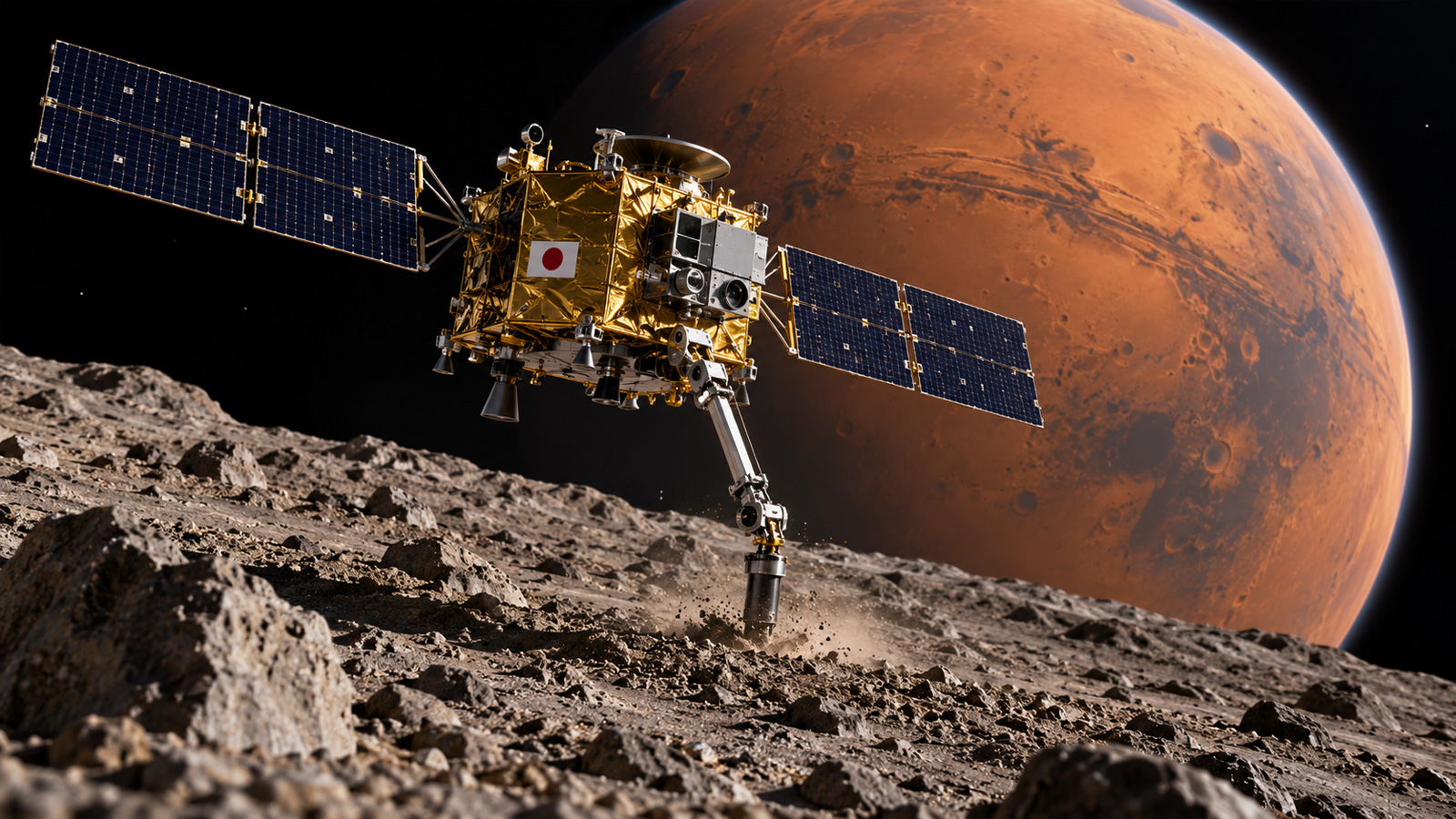
Japan has launched a spacecraft on a mission to collect soil and rock samples from Phobos, one of Mars’ two moons. Scientists hope the samples will help them understand how the moons formed and learn more about the early solar system.
The Martian Moons eXploration (MMX) spacecraft was launched aboard Japan’s H3 rocket from the Tanegashima Space Centre in Kagoshima Prefecture at 4.41 a.m. on Tuesday, the Japan Aerospace Exploration Agency (JAXA) said.
The spacecraft is expected to reach Mars in August 2027. It will study Phobos and attempt to collect at least 10 grams of material from beneath its surface. The samples are expected to return to Earth in July 2031, with the capsule scheduled to land in Australia.
Phobos is about 27 km wide and orbits Mars at a distance of around 6,000 km. The planet’s other moon is called Deimos.
As part of the mission, the spacecraft will release a small rover named Idefix to study Phobos’ surface and help identify a safe place for landing. The rover was developed by French and German space agencies in collaboration with JAXA.
Scientists have two main theories about how the moons formed. One suggests that they are asteroids pulled in by Mars’ gravity. The other says they formed from debris left behind after a large object collided with Mars.
Studying the samples could help scientists find out which theory is correct. It may also provide clues about how water and organic materials spread through the early solar system and the conditions that could have supported life.
The mission involves JAXA, Mitsubishi Electric, universities and research institutes, along with international partners such as NASA and the European Space Agency. It builds on Japan’s earlier asteroid sample-return mission, Hayabusa2, which brought material from the asteroid Ryugu to Earth in 2020.
China is also planning a mission to bring samples back from Mars. Its Tianwen-3 spacecraft is scheduled to launch in 2028 and could return samples by 2031.
JAXA hopes the MMX mission will improve space exploration technology and help prepare for future missions to Mars.