


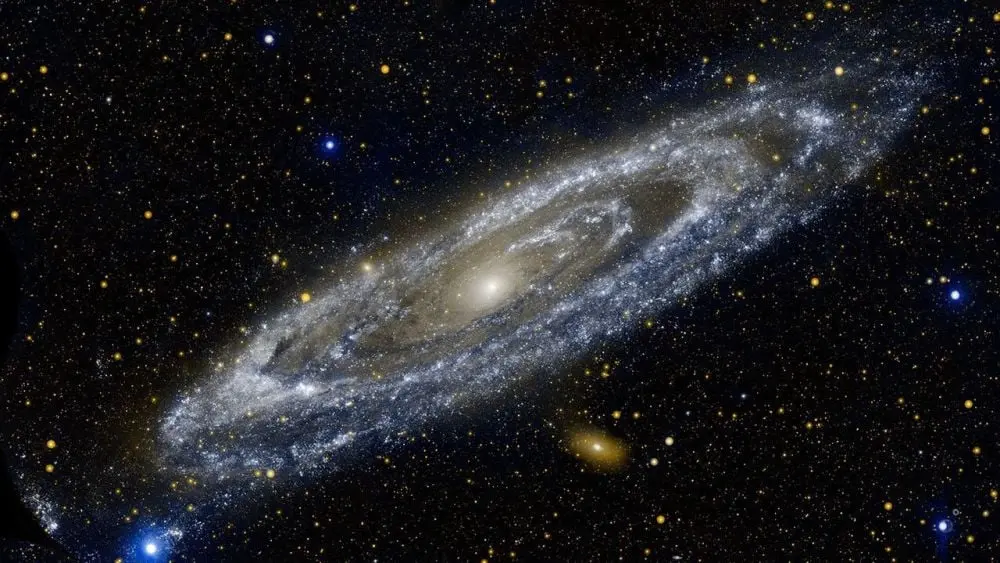
Astronomers have captured an unusually complete record of two stars becoming one in the Andromeda galaxy, offering the first direct view of a long-predicted stage in the lives of some binary star systems.
The event, known as AT 2025abao and nicknamed Bao by the research team, involved an ageing giant star and a smaller companion. The pair are about 2.5 million light-years from Earth in the outskirts of Andromeda, the large galaxy closest to the Milky Way. The giant is estimated to have about seven times the mass of the Sun, while its companion had roughly 0.7 solar masses.
The discovery is important because astronomers have long suspected that a smaller star can become trapped inside the extended outer layers of a much larger star. This stage is called common-envelope evolution.
The team behind the new study followed Bao for years before its final outburst. Data from NASA's NEOWISE telescope showed that the system began brightening and producing dust in 2018. The gradual change continued for about seven years before a much brighter eruption in late 2025.
Researchers combined observations from several ground-based and space telescopes. NASA's James Webb Space Telescope added a particularly valuable view: it observed Bao 47 days after the eruption, the earliest follow-up observation of this kind of event reported by the team. Webb's infrared measurements helped scientists examine the dust and material expelled from the system.
The researchers concluded that the smaller star spiralled into the giant and merged with its core. The final interaction appears to have thrown part of the giant's outer envelope into space. The result gives astronomers a rare opportunity to compare real observations with models of how stars exchange energy and lose material during a common-envelope phase.
The discovery does not mean that every pair of stars in this situation will merge. Some companions may survive after the giant loses its outer layers, leaving behind a much tighter pair. Bao is valuable because it shows one possible outcome in unusually clear detail.
By following the system before, during and after its eruption, astronomers have gained a rare look at a process that usually unfolds too slowly or unpredictably to witness. Continued observations will help establish what remains after the merger and how closely the system matches current models.