


A flower no bigger than a grain of rice has been identified inside a rock collected more than 130 years ago, giving scientists a rare glimpse of plant life from about 100 million years ago.
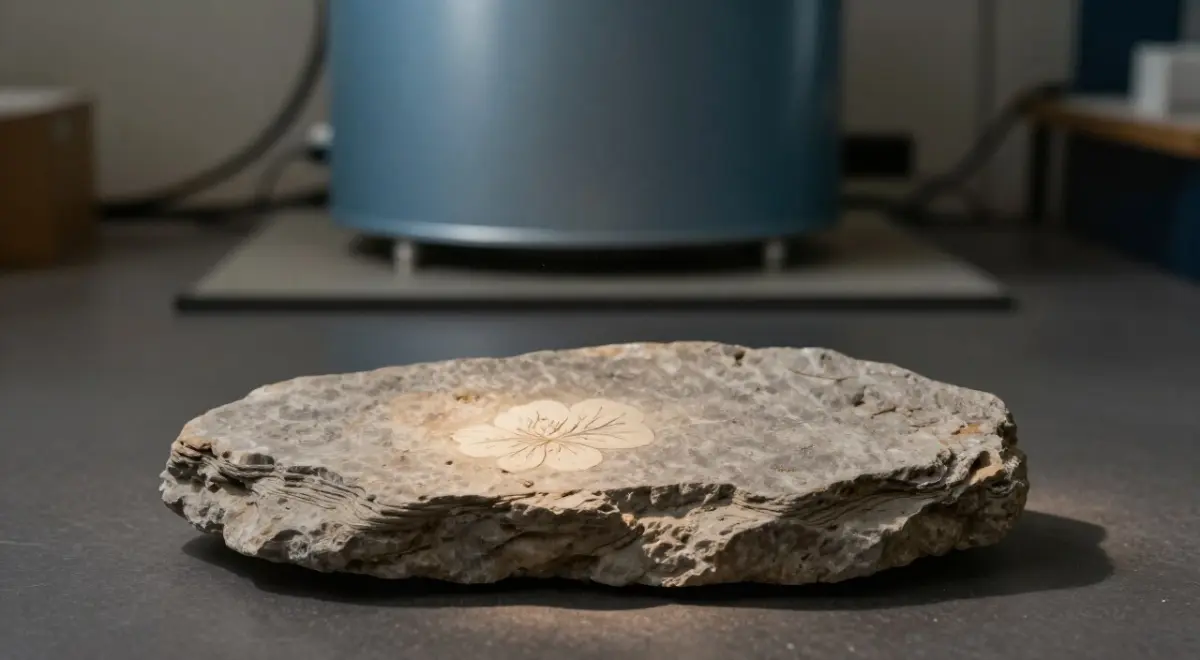
The fossil, named Tomlinsoniella pedicellata, was found in a rock from Kansas that had been held in the Smithsonian National Museum of Natural History's collections. The specimen dates to the middle of the Cretaceous period, when dinosaurs lived on Earth. Researchers uncovered the flower while using micro-computed tomography, or micro-CT, an X-ray scanning method that can reveal structures hidden inside solid objects.
Paleobotanist Steven Manchester of the Florida Museum of Natural History was examining a rock sample for another fossil flower when the scan revealed a second, previously unnoticed shape. The new fossil had not survived as an ordinary preserved plant. Instead, the flower had decomposed after being buried in clay-rich sand, leaving a hollow impression in the rock. The mineral material around it preserved the flower's shape.
The scans allowed the researchers to build a three-dimensional picture of the tiny structure. It measures about 1.5 millimetres high and 1.2 millimetres across. Its parts are arranged in a pattern familiar in many modern flowering plants: three sepals, three petals, six stamens and three separate carpels, which are the female reproductive structures.
The researchers say the fossil is the first evidence of a monocot flower from the Dakota Formation, the geological layer in Kansas where the rock was found. Its structure also appears to be the earliest clear fossil evidence of the distinctive flower pattern seen in many monocots. The team found that it most closely resembles an extinct palm, possibly from the fan-palm group.
However, the scientists have not claimed that the plant is definitely an ancestor of modern palms. The fossil could belong to an extinct branch of monocots, and more work is needed to establish where it fits on the plant family tree. The discovery is therefore an important clue, rather than a final answer, to the early evolution of flowering plants.
The discovery also highlights the value of museum collections. A specimen gathered in the 19th century has yielded new information because scientists now have imaging tools that can examine its interior without breaking it apart. The tiny flower had been hidden in plain sight for more than a century, but modern scanning has helped reveal a piece of plant history from the age of dinosaurs.